At What Age Do Most Babies Sleep Through the Night
© 2021 Gwen Dewar, Ph.D., all rights reserved
 opens IMAGE file
Studies suggest that about babies brainstorm to "sleep through the nighttime" (at least 5-six hours without parental intervention) past 3-6 months of age. Simply some infants have longer, and the road to progress can be bumpy. Even afterward babies feel their first, long episodes of nighttime sleep, they may follow an irregular pattern — sleeping through the night occasionally, but not consistently.
When will my babe begin to slumber through the night?
It's one of the most common questions that new parents ask.
Simply unfortunately, answers can exist tricky, and it's not only because every baby is unlike. The very concept of "sleeping through the nighttime" is problematic.
Why? Because nobody truly "sleeps through the night."
Non if by "sleeps through the night" we mean something similar "existence continuously unconscious the entire fourth dimension."
As I explain in my article on opens in a new windownight wakings, the brain engages in frequent shifts between unlike stages of sleep. And all of us feel numerous episodes of waking or virtually-waking during the dark.
If we feel otherwise — if we awaken in the morning time convinced that we slept continuously ("like a log") — it's simply because nosotros don't remember these brief interruptions.
And babies? Sleep scientists take monitored infant sleep, using electrodes, actigraphs, and continuous video and audio recordings. They've confirmed that babies, too, experience multiple arousals and awakenings at night.
For example, in a report using actigraphs, researchers found that 6-month-old babies didn't slumber continuously for more than most 72 minutes at stretch (Sher et al 2004).
Then if we interpret "sleeping through the nighttime" as "sleeping non-stop," this isn't something that healthy humans practise.
But what if we interpret "sleep through the night" in a different style? To mean something like "maintaining mostly continuous sleep, without parental intervention, for a period of at least five or half-dozen hours?"
At present the ideaisn't that your infant never arouses or awakens. Instead, we focus on the more realistic expectation that your babe volition learn to handle night wakings on his or her own.
When your babe experiences one of those inevitable arousals or awakenings, your infant will — speedily and quietly — resume sleeping. Without waking you up.
If that's what we mean by "sleeping through the night," then studies indicate that some parents are experiencing relief by 3 months. And based on studies conducted in Western countries, nearly parents study that their half-dozen calendar month-old babies are capable of sleeping at least v-6 hours at a stretch.
For instance, in a study of approximately 100 families in the United Kingdom, researchers measured infant slumber in two means: (1) past monitoring babies throughout the nighttime with video cameras; and (2) past asking parents to keep written sleep diaries (St James-Roberts et al 2015).
The objective video recordings told a clear story of progress over time.
When babies were just 5 weeks old, the average elapsing of visibly uninterrupted sleep was about 2 hours. By 3 months, this average elapsing had jumped to three.5 hours.
But the more impressive numbers came from the parental slumber diaries:67% of parents claimed that their 3-month-onetime babies were sleeping continuously for v hours or more!
Why the discrepancy? The video recordings leave u.s.a. no incertitude. Some parents were simply unaware that their infants had awakened. The night wakings had been cursory, and the babies had remained quiet. The babies had re-settled themselves back to sleep —without awakening their parents.
It's a happy circumstance, and other research suggests it's pretty commonplace. At least, that seems to be the case in English language-speaking countries.
For example, researchers in New Zealand recruited 75 families with babies under the age of ane month. Then, every month, they asked parents to document a unmarried nighttime of their babies' sleep behavior (Henderson et al 2010).
The upshot was a month-past-month snapshot of each infant's sleep development, and researchers found evidence for improvements around iii-4 months.
When babies were 2 months old, simply 6 of them — 8% — experienced a nighttime of sleeping for five consecutive hours between midnight and 5am.
But past the time babies were three months old, this number had jumped to xxx babies — twoscore% of the total. And by 4 months? Just over 50% of the infants had slept between midnight and 5 am.
Fast forward to 6 months, and fifty-fifty more parents were reporting long, night sleep intervals. Nearly 70% said their babies slept between midnight and 5am.
Other studies — representing the experiences of thousands of families in Australia, Canada, and the United States — written report similar trends. When parents are asked to keep slumber diaries, or to just recollect how long their babies accept slept in a given nighttime, nigh study that their babies have slept for intervals of at least five hours by the time they are 3-5 months old (Sadeh et al 2009; Teng et al 2012).
What about sleeping for even longer stretches of time without parental intervention? When practise babies sleep for seven-8 hours at a fourth dimension?
In the New Zealand report mentioned above, most (52%) said their 6-month-onetime babies had slept for 8 hours — staying tranquillity between 10pm and half dozen am.
And in a big study of more 5,000 families in the United states of america and Canada, researchers establish that the longest sleep episode for babies vi-8 months old ranged between 5 and 10 hours, with the average episode lasting approximately 7 and a half hours (Sadeh et al 2009).
Does this mean that you can look that your baby will exist "sleeping through the night" by 6 months?
No. There are a couple of big caveats to keep in mind.
one. There's a considerable amount of variation between individuals.
Certain, most babies might be "sleeping through the dark" by half-dozen months. But we're still left with a lot of babies who aren't.
For case, in a survey of more than than 380 Canadian parents, 62% said their 6-month-onetime babies were sleeping uninterrupted for half dozen hours each night.
Simply 38% said their babies were sleeping for shorter stretches of time (Pennestri et al 2018).
And let'due south take another look at the New Zealand study — the 1 that asked parents to certificate a single night of their babies' sleep behavior, one night per month.
At the 9 month checkpoint, approximately 25% of parents were in this category.
And past the stop of the written report — at 12 months — 16% of parents reported that their babies had failed to stay comatose between midnight and 5 a.m..
That'southward a lot of older babies who weren't sleeping during the midnight-to-5 a.m. interval. At least not on the item dark in which their parents kept a sleep diary.
And that brings me to the second caveat.
2. The same individual babe may feel a lot of variation from one night to the next.
Even if you lot've experienced an episode of "sleeping through the nighttime," that doesn't hateful your babe will proceed doing it reliably — night after night.
On the contrary, information technology may be normal for young babies to go back and forth — experiencing longer sleep bouts on some nights, and shorter slumber bouts on others.
In a recent study of six-month-erstwhile babies in Canada, Marie-Hélène Pennestri and her colleagues demonstrated this point. They asked parents to go on records of their babies' sleep behavior — not just for one nighttime, but for 13 consecutive nights. And this longer-term approach revealed something very interesting.
Most parents reported that their babies slept for a six-hour stretch at least once. In fact, 50% of the babies experienced at to the lowest degree i night of sleeping for eight hours or more than.
Just most babies weren't sleeping this mode habitually. It was an occasional affair.
For example, take the benchmark of sleeping for 6 hours without parental intervention. Of the 44 infants participating in this study, only 3 babies did this for all 13 nights.
And the criterion of sleeping for eight hours without parental intervention? But one baby managed to practise that across all 13 nights.
The more than normal pattern was to be…irregular. As the researchers explain:
opens in a new window"On average, mothers reported that their babe slept 6 hours consecutively for almost 5 nights out of 13."
And it's worth pointing out: Nine of the babies never slept for vi hours consecutively. And 22 babies — 50% of the total — never slept for 8 hours consecutively (Pennestri et al 2020).
What virtually cultural differences? Differences in the manner families handle sleep?
Large studies contrasting East Asian and Western countries have documented a consequent regional difference: Parents in East Asian countries tend to report shorter times for an infant's longest nighttime sleep episode (Mindell, Sadeh, and Kohyama et al 2010; Mindell, Sadeh, and Weigand et al 2010).
Researchers note that this divergence of result is linked to a difference in bedtime practices. East Asian parents are more probable to be present when their babies fall asleep at bedtime, and parental presence at slumber onset is linked with shorter nighttime sleep bouts (Mindell, Sadeh, and Weigand et al 2010).
There is besides evidence that room-sharing is linked with shorter dark slumber episodes.
For instance, a written report in Israel tracked approximately 140 families with immature infants. Infant sleep was measured with both actigraphs and parental sleep diaries. The longest sleep episode tended to be shorter among babies who shared a bedroom with their parents (Volkovich et al 2018)
Okay. And then it's of import to understand that in that location's a lot of variability. Just is there annihilation parents can exercise to encourage babies to sleep through the night?
Aye.
Newborn babies need to awaken ofttimes to feed. So we can't expect them to slumber for 5-six hours at a fourth dimension.
But there are however steps parents can take — from the very first — to help their infants develop mature sleeping patterns.
For case, it's useful to understand the biological science of infant slumber, and to provide babies with the environmental support they demand to get their circadian rhythms in sync with the natural cycle of 24-hour interval and nighttime.
This includes exposing babies to activity and bright light during the daytime. It also includes avoiding bright lights and excitement during the evening. Encounter opens in a new windowthis Parenting Science article for details.
It's also important to avoid accidently enkindling a sleeping infant.
This might sound obvious, but babies can twitch, move, and vocalize in their slumber. It'southward surprisingly easy to make the mistake of thinking that a sleeping baby is awake and ready to interact. And so you lot brand your move — and end up awakening a sleeping baby.
And even if you are certain that your baby has awakened, y'all might want to wait a moment before "swooping in."
Remember those 3-month-erstwhile babies who re-settled themselves back to sleep — without their parents' assistance? Your infant might be capable of this — at least sometimes. But you will never know if y'all arbitrate also soon.
In addition, there is show that we tin encourage babies to sleep longer by introducing a slight delay in the timing of their feeds.
When your baby awakens in the center of the night, you might be tempted to begin a feeding session immediately. But what if y'all do something else instead? Like re-swaddling your baby? Or walking with your baby? Or otherwise delaying the feeding for more than than lx seconds?
Researchers accept establish links between such delaying tactics and the development of longer sleep intervals.
In one study, parents who imposed a short delay before feeding (60 seconds or longer) were twice as probable to accept babies who — by the age of three months — slept for at least 5 hours at a stretch during the night (St. James-Roberts et al 2017).
There is too evidence that babies will feel longer sleep episodes if nosotros avert letting them fall asleep while they are feeding.
For case, in a large survey of North American families, parents tended to report shorter night slumber bouts if they breastfed their babies back to sleep (Sadeh et al 2009).
And yous may want to consider other tactics.
Equally I explain in my article about "dream feeding," your baby might sleep longer if yous provide him or her with a big repast immediately before bedtime.
Another promising approach is to innovate a soothing bedtime routine (Mindell et al 2009).
For a more detailed discussion of these and other tactics, meet my commodity, opens in a new window"15 baby sleep tips."
More Parenting Science articles
- opens in a new windowNewborn sleep patterns
- opens in a new windowFinding the right infant sleep aid: Show-based tips for getting your baby to slumber
- opens in a new windowBaby sleep requirements: How much slumber do they really need?
- opens in a new windowInfant sleep problems: A trouble-shooting guide
References: When do babies sleep through the night?
Dias CC, Figueiredo B, Rocha Thousand, Field T. 2018. Reference values and changes in infant slumber-wake behaviour during the first 12 months of life: a systematic review. J Sleep Res. 2018 Oct;27(5):e12654.
Figueiredo B, Dias CC, Pinto TM, Field T. 2016. Infant sleep-wake behaviors at two weeks, iii and six months. Baby Behav Dev. 44:169-78.
Galland BC, Taylor BJ, Elder DE, Herbison P. 2012. Normal sleep patterns in infants and children: a systematic review of observational studies. Sleep Med Rev. 16(3):213-22.
Henderson JM, French republic KG, Owens JL, Blampied NM. 2010. Sleeping through the dark: the consolidation of cocky-regulated sleep across the showtime yr of life. 126(5):e1081-7
Iglowstein I, Jenni OG, Molinari L, Largo RH. 2003. Slumber duration from infancy to boyhood: Reference values and generational trends. Pediatrics 111(2): 302-307.
Mindell JA, Leichman ES, Composto J, Lee C, Bhullar B, Walters RM. 2016. Development of infant and toddler sleep patterns: real-earth data from a mobile application. J Sleep Res. 25(v):508-516.
Mindell JA, Sadeh A, Kwon R, Goh DY. 2013. Cross-cultural comparison of maternal sleep. Sleep. 36(11):1699-706.
Mindell JA, Sadeh A, Kohyama J, How TH. 2010. Parental behaviors and sleep outcomes in infants and toddlers: a cross-cultural comparison. Sleep Med. xi(four):393-nine
Mindell JA, Sadeh A, Wiegand B, How Th, Goh DY. 2010. Cross-cultural differences in baby and toddler sleep. Sleep Med. 11(iii):274-80.
Mindell JA, Telofski LS, Wiegand B, Kurtz ES. A nightly bedtime routine: impact on sleep in immature children and maternal mood. 2009. Sleep 32:599e606.
Pennestri MH, Burdayron R, Kenny S, Béliveau MJ, Dubois-Comtois M. 2020. Sleeping through the night or through the nights? Sleep Med. 76:98-103.
Pennestri MH, Laganière C, Bouvette-Turcot AA, Pokhvisneva I, Steiner M, Meaney MJ, Gaudreau H; Mavan Enquiry Team. 2018. Uninterrupted Infant Sleep, Evolution, and Maternal Mood. Pediatrics. 142(6):e20174330
Sadeh A, Mindell JA, Luedtke K and Wiegand B. 2009. Sleep and sleep ecology in the get-go 3 years: a web‐based study. J Sleep Res 18: 60–73.
Scher A, Epstein R and Tirosh East. 2004. Stability and changes in slumber regulation: a longitudinal study from 3 months to 3 years. Int J Behav Dev 28: 268–274.
St James-Roberts I, Roberts One thousand, Hovish K, Owen C. 2017. Video prove that parenting methods predict which infants develop long nighttime-time sleep periods by three months of age. Prim Health Care Res Dev. eighteen(iii):212-226.
St James-Roberts I, Roberts Thou, Hovish G, Owen C. 2015. Video Evidence That London Infants Tin Resettle Themselves Back to Sleep Subsequently Waking in the Night, besides every bit Sleep for Long Periods, by 3 Months of Age. J Dev Behav Pediatr. 36(v):324-nine.
Teng A, Bartle A, Sadeh A and Mindell J. 2012. Infant and toddler sleep in Commonwealth of australia and New Zealand. J. Paediatrics Child. Health 48: 268–273.
Volkovich Due east, Bar-Kalifa E, Meiri One thousand, Tikotzky L. 2018. Mother-baby sleep patterns and parental functioning of room-sharing and solitary-sleeping families: a longitudinal report from iii to 18 months. Sleep. 41(2):zsx207.
Prototype credits for "When do babies sleep through the night?"
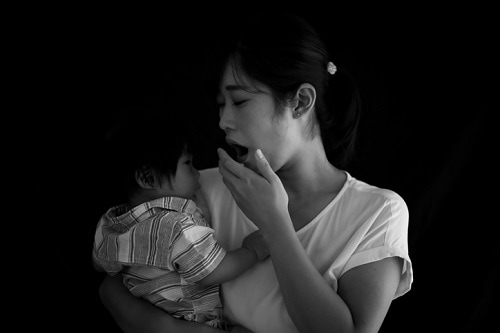
Title epitome of yawning female parent and infant by yamasan / istock
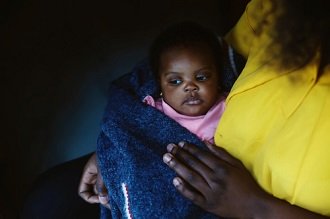
Prototype of baby awake at nighttime in mother's arms past Mila Supinskaya Glashchenko / shutterstock
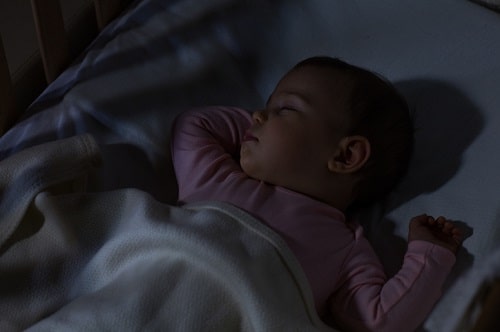
Image of babe in pink sleeping past mdphoto16 / istock
Source: https://parentingscience.com/when-do-babies-sleep-through-the-night/
0 Response to "At What Age Do Most Babies Sleep Through the Night"
Post a Comment