How to Upload Photos to Lightroom Straight From Camera
For those new to the software, the process of importing photos into Lightroom tin be somewhat mysterious.
It'south not uncommon for people to unwittingly make multiple catalogues, duplicate their photos, lose rail of where they're sending their images or, in farthermost cases, delete them.
It'southward therefore very important to understand exactly what the import process does from the kickoff.


What is Importing?
You may have heard people talking well-nigh 'importing photos into Lightroom' as if they're somehow adding the images themselves to Lightroom.
This is non actually the case.
In essence, importing your photos boils down to telling Lightroom where they are in your storage.
The location of your photos and photographic camera-generated EXIF data (shutter speed, aperture, time and date, etc.) are all entered into Lightroom's catalogue. It'due south rather like filling in an quondam style index bill of fare for a new book in a library.
You cannot edit whatever photos in Lightroom until you've first imported them. This is done from the Library Module.
Check that the Library Module has been selected in the top module option strip. If you can't encounter it, click the little arrow at the top centre. It should expect similar this:

On the left-hand side of the screen, you should run into a pane containing several other panels and, at the bottom of this, yous should see the 'Import' button. If this pane is not visible, merely tap the TAB cardinal and information technology should appear as follows:
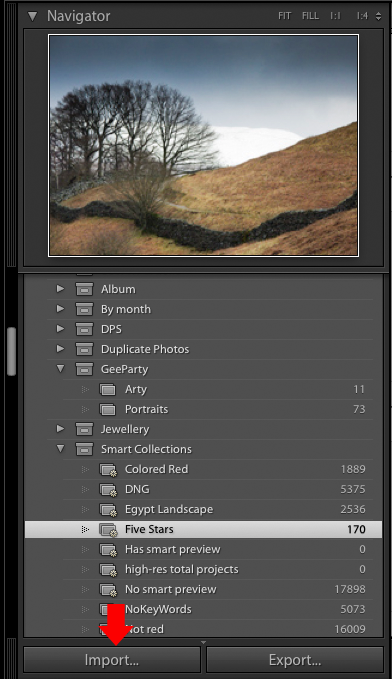
Importing from a Photographic camera
To import pictures from your camera, connect it to your calculator using a USB cablevision (there'due south no need to utilize a card reader or other special software). Switch the camera on and click the Import push button to bring upward the import dialogue box:
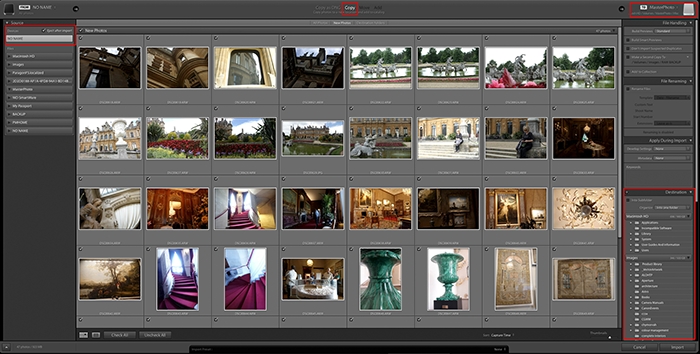
The layout of this dialogue box is very logical—you just suit the settings in the windows from left to correct and then hit the Import push.
The Left Window
This shows you the diverse places from which you can import photos. It will testify all connected hard drives, memory cards and cameras.
Your camera should appear in the list (information technology may show upwards with equally your camera'south model name or it may merely be called 'NO Name').
Click the item respective to your camera and you should encounter the thumbnails begin to appear in the eye window, which is the master function of the screen.
The Centre Window
The images stored on your camera will appear as thumbnails in the main area of the screen.
Untick any that you lot don't want to import. If any photos appear greyed out, this indicates that Lightroom thinks y'all've already imported them.
The choice at the tiptop center of this screen is very important.
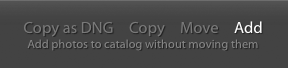
Lightroom will normally select the right option; this doesn't always happen, so it pays to check this. There are four options: 'Copy as DNG', 'Copy', 'Motion' and 'Add'.
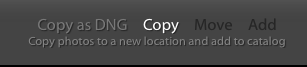
When importing images into Lightroom from a camera's media card, you demand to re-create the photos to your reckoner's hard drive so that you lot can reuse your memory card.
- 'Copy' will copy each of the selected images equally-is
- 'Copy as DNG' volition convert any RAW files it finds on the card into the Adobe Digital Negative format, and and then save them. This takes a little longer but it's a expert format to use for archival purposes and it takes slightly less difficult drive space.
The 'Move' and 'Add' options should not exist available but they can sometimes be—just check that 'Add together' has not been selected otherwise you will not be able to edit the photos subsequently.
The Correct Window
The destination to which your photos will be copied is displayed just to a higher place this panel.
This can be any drive, either the computer'southward own internal difficult drive or an external USB drive. Many people choose to take a general purpose folder on their chosen drive to which they import all their images.
Select the destination binder by clicking the meridian right surface area to see a list of recent destinations or click on a folder from the Destination panel at the bottom of the window.
If you desire to create a new binder to which the photos volition be copied, click the '+' push at the very top of the Destination panel.
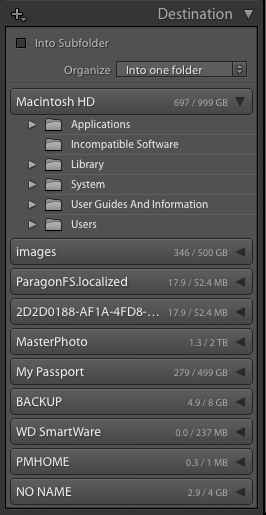
Some people notice that after importing photos into Lightroom they have loads of unwanted sub-folders named by appointment, with only a few photos in each one.
This is because the 'Organize' drib-downwards box in the Destination panel was prepare to 'By Date' instead of 'Into one binder' as shown above.
If you lot desire to place your photos into a new subfolder, you tin tick the 'Into Subfolder' box and supply a suitable proper noun.
Import Options
Lightroom allows you to perform a number of useful tasks. You lot tin utilize these every bit photos are copied to your computer and added to the catalogue.
File Handling
Options for how each imported file is handled are listed in the 'File Handling' window.
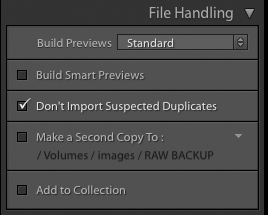
Here's a rundown of what each of these options practice:
Build Previews
In lodge to brandish thumbnail photos in the diverse Lightroom modules, it's necessary to build previews of each photo.
This happens during the import process. You can use the drop-downwards box in this panel to choose from three types of previews (other than the Standard preview). These previews differ by quality and are as follows:
- Standard – This is the default preview. Standard uses the Photographic camera Raw engine for processing and so sometimes appear unlike from minimal or embedded previews.
- Minimal – This preview produces low resolution camera-generated JPEG images that are very fast to create but not color managed.
- Embedded & Sidecar – These are larger photographic camera-generated previews that have a little longer to create than minimal previews.
- 1:one – These are total-sized images that Lightroom uses when you lot zoom into an image.
- When you tell Lightroom to generate 1:one previews, information technology also generates minimal and standard previews, so that all three are available equally the software requires. Full-sized previews tin take a long fourth dimension to generate and make the import process very tiresome.
Build Smart Previews
If you accept your principal photos ever available to the catalogue, you lot can leave the 'Build Smart Previews' box unticked.
If you lot want to edit your photos when the master images are non online (when the external USB bulldoze on which they reside has been unplugged, for instance), Smart Previews allow you to brand edits with missing master photos.
But if you don't intend to do this, leave the box unticked. Smart Previews will take upwards extra space on your hard drive. You can brand a Smart Preview easily afterward on if y'all need to.
Don't Import Suspected Duplicates
Sometimes photos are left on a media card between import sessions, from one shoot to the side by side.
This can make it hard since some photos on the bill of fare will be new and some will have already been imported to Lightroom.
In cases like this, it's possible that the same photo will be copied to more than ane identify on your hard drive, which ends up getting messy when importing.
To assistance avoid this happening, tick the 'Don't Import Suspected Duplicate' box.
Lightroom volition then check the EXIF data for each photo against those information technology already knows most and grey out any it thinks you already take in the catalogue.
Ideally, y'all should import all the images on a card, and once safely copied to your hard drive, the media carte should be re-formatted ready for the side by side shoot. Still, non everyone does this, based on personal preference and habit.
So even if you ever reformat your cards, information technology's generally a expert idea to tick this box as it will aid keep things tidy.
Brand a 2d Re-create To:
You don't desire random duplicates of some of your photos, but you should accept comprehensive back-ups.
All hard drives will fail eventually so having access to a re-create of each photo is a good insurance confronting accidental deletion or hardware failure.
The best system is to have a proper incremental back-up procedure in place using proprietary backup software. Nevertheless, if you don't enjoy this level of protection, Lightroom does offer some kind of solution.
If you tick the 'Make a Second Copy To:' box, y'all can specify another difficult drive folder to which Lightroom will copy your photos during import.
This saves y'all from remembering to back upwardly your photos just information technology doesn't allow y'all to rename any photos during the process. It's but a direct copy of what happened to be on the camera's media card—rough simply better than nothing.
Add to Drove
If you tick this box, Lightroom can automatically add together all the photos you lot're importing so to an existing collection.
File Renaming
If you're trying to import photos from several unlike cameras, you'll rapidly discover that the chances of having ii or more photos with the same file name is quite high.
Considering of this, information technology's useful to be able to rename the rather cryptic file names your camera generates to more than recognisable and unique names.
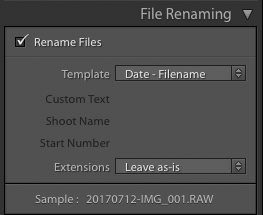
To practice this, just tick the 'Rename Files' box and select a template from the drib-down box. In the example in a higher place, the template called adds the date to the front of the filename provided by the photographic camera.
If y'all're using several cameras on the same shoot, you might instead desire to select a template that includes a custom name for a detail camera.
There are lots from which to choose only if null suits your fashion of working, you can opt to make your own template by selecting 'Edit'.
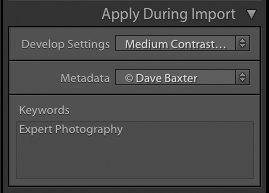
Apply During Import
This import selection allows you to add additional information (metadata) to your photo files.
A handy tip is to use the 'Apply During Import' panel to add a copyright in the metadata for each paradigm imported.
If you've already found some develop adjustments you lot like and you've saved them as a preset, select this or any other preset from the Develop Settings drop-down box. Lightroom will so apply those settings to each imported photo.
This panel also allows you lot to add keywords to assistance you lot with the task of organising photos in Lightroom.
Salve Your Import Settings
Finally, at the bottom of the import screen, there'southward an selection to salvage your import settings equally a named preset—just click on the arrows and select 'Save Current Settings as New Preset…'
How to Import From A Hard Bulldoze
Importing from a hard drive is simple. Lightroom only needs to know where the photos are already located.
There is no need to copy or rename them, but it's all besides easy to brand accidental copies if yous don't carefully watch the settings.
Follow these steps when importing from a hard drive:
- In the Source console, select the folder whose photos yous want to import. If it contains subfolders, be sure to tick the 'Include Subfolders' box in order to see thumbnails of the photos in this folder and all its subfolders.
- Brand sure yous select 'Add' and not 'Re-create'. This will leave the photos in their current folders and volition avoid making duplicates.
- Set the options nether File Treatment as for doing a camera import. Note that making a second re-create is greyed-out with the Add option.
- Under 'Apply During Import' set as per the photographic camera import.
Source: https://expertphotography.com/how-to-import-photos-into-lightroom-a-beginners-guide/
0 Response to "How to Upload Photos to Lightroom Straight From Camera"
Post a Comment