what is the equation of the line parallel to the given line with an x-intercept of 4? y = x +
Graphs
36 Use the Slope–Intercept Course of an Equation of a Line
Learning Objectives
By the end of this section, you lot will be able to:
- Recognize the relation between the graph and the slope–intercept form of an equation of a line
- Identify the gradient and y-intercept form of an equation of a line
- Graph a line using its gradient and intercept
- Choose the well-nigh convenient method to graph a line
- Graph and interpret applications of slope–intercept
- Use slopes to identify parallel lines
- Use slopes to place perpendicular lines
Recognize the Relation Between the Graph and the Gradient–Intercept Form of an Equation of a Line
Nosotros accept graphed linear equations by plotting points, using intercepts, recognizing horizontal and vertical lines, and using the point–slope method. Once we come across how an equation in slope–intercept form and its graph are related, we'll have one more method we can use to graph lines.
In Graph Linear Equations in Ii Variables, nosotros graphed the line of the equation  past plotting points. Come across (Effigy). Let's observe the slope of this line.
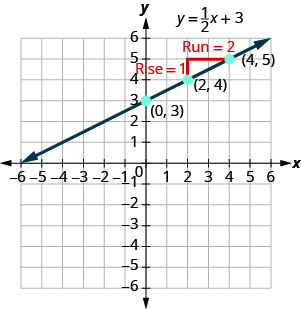
The blood-red lines show united states of america the rise is 1 and the run is two. Substituting into the slope formula:

What is the y-intercept of the line? The y-intercept is where the line crosses the y-centrality, so y-intercept is  . The equation of this line is:

Notice, the line has:

When a linear equation is solved for  , the coefficient of the
  term is the slope and the constant term is the y-coordinate of the y-intercept. We say that the equation is in slope–intercept course.
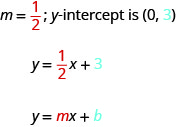
Slope-Intercept Form of an Equation of a Line
The gradient–intercept form of an equation of a line with slope  and y-intercept,
  is,
is,

Sometimes the gradient–intercept form is chosen the "y-course."
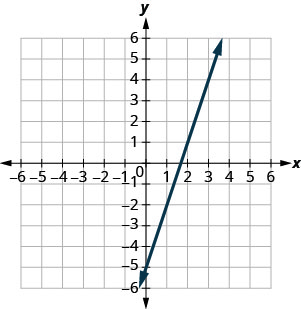
Use the graph to find the gradient and y-intercept of the line,  .
.
Compare these values to the equation.
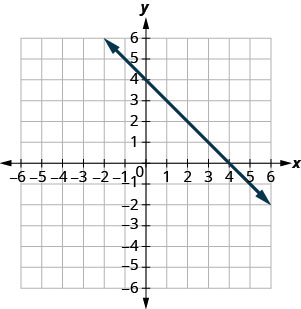
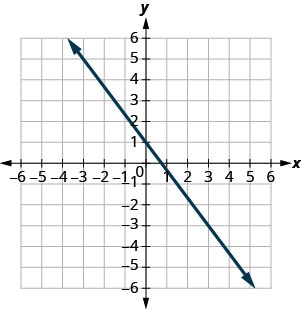
Use the graph to detect the gradient and y-intercept of the line  . Compare these values to the equation .
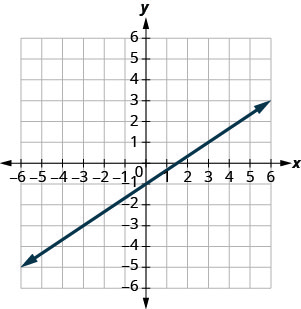
slope  and y-intercept
Apply the graph to observe the slope and y-intercept of the line . Compare these values to the equation .
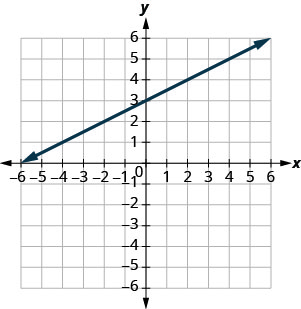
slope  and y-intercept
Identify the Slope and y-Intercept From an Equation of a Line
In Understand Slope of a Line, we graphed a line using the slope and a point. When we are given an equation in slope–intercept form, we can apply the y-intercept as the point, and then count out the slope from there. Allow'southward do finding the values of the slope and y-intercept from the equation of a line.
Identify the gradient and y-intercept of the line with equation  .
.
Solution
We compare our equation to the slope–intercept class of the equation.
 | |
| Write the equation of the line. |  |
| Identify the slope. |  |
| Identify the y-intercept. |  |
Identify the slope and y-intercept of the line  .
.

Identify the gradient and y-intercept of the line  .
.

When an equation of a line is not given in slope–intercept form, our first step volition exist to solve the equation for .
Identify the slope and y-intercept of the line with equation  .
.
Place the slope and y-intercept of the line  .
.

Identify the slope and y-intercept of the line  .
.

Graph a Line Using its Slope and Intercept
At present that nosotros know how to detect the slope and y-intercept of a line from its equation, we can graph the line by plotting the y-intercept so using the gradient to detect another signal.
How to Graph a Line Using its Slope and Intercept
Graph the line of the equation  using its slope and y-intercept.
Graph the line of the equation  using its slope and y-intercept.
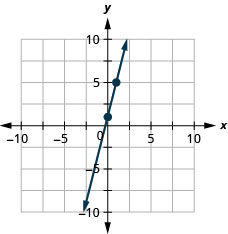
Graph the line of the equation  using its slope and y-intercept.
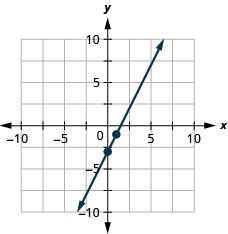
Graph a line using its slope and y-intercept.
- Find the slope-intercept form of the equation of the line.
- Identify the slope and y-intercept.
- Plot the y-intercept.
- Utilise the gradient formula
 to place the rise and the run.
 - Starting at the y-intercept, count out the ascension and run to mark the 2nd indicate.
- Connect the points with a line.
Graph the line of the equation  using its gradient and y-intercept.
Graph the line of the equation  using its gradient and y-intercept.
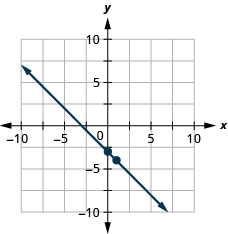
Graph the line of the equation  using its slope and y-intercept.
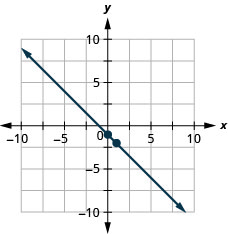
Graph the line of the equation  using its slope and y-intercept.
Graph the line of the equation  using its slope and y-intercept.
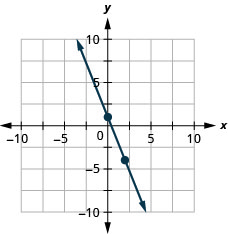
Graph the line of the equation  using its slope and y-intercept.
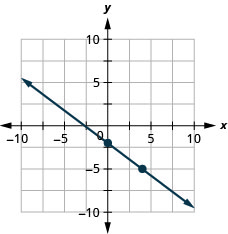
Graph the line of the equation  using its slope and y-intercept.
Graph the line of the equation  using its gradient and y-intercept.
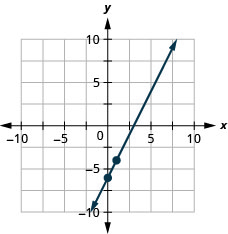
Graph the line of the equation  using its gradient and y-intercept.
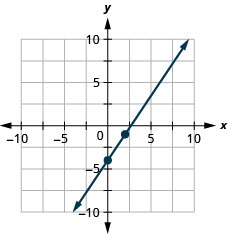
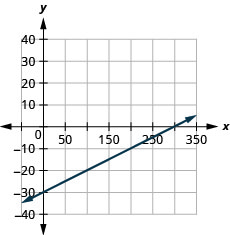
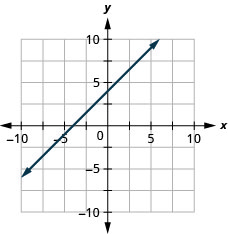
We accept used a grid with and both going from virtually  to x for all the equations we've graphed so far. Not all linear equations tin can be graphed on this small grid. Often, especially in applications with real-world information, we'll need to extend the axes to bigger positive or smaller negative numbers.
Graph the line of the equation  using its slope and y-intercept.
Graph the line of the equation  using its slope and y-intercept.
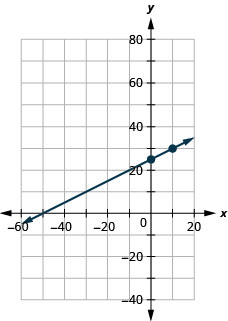
Graph the line of the equation  using its gradient and y-intercept.
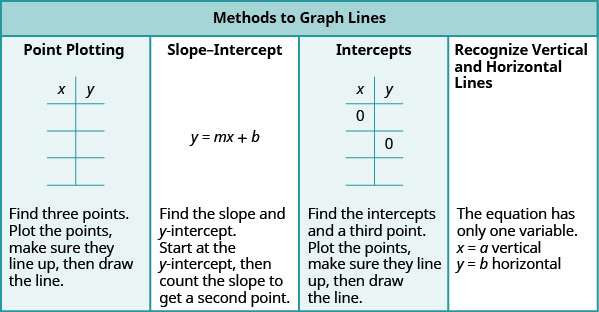
Now that we have graphed lines by using the slope and y-intercept, let'due south summarize all the methods we take used to graph lines. See (Figure).
Choose the Virtually Convenient Method to Graph a Line
Now that nosotros accept seen several methods we can utilise to graph lines, how exercise we know which method to use for a given equation?
While we could plot points, use the gradient–intercept form, or detect the intercepts for any equation, if we recognize the most user-friendly way to graph a certain type of equation, our work will be easier. More often than not, plotting points is not the most efficient manner to graph a line. We saw better methods in sections 4.three, iv.four, and earlier in this section. Permit'south look for some patterns to help determine the most convenient method to graph a line.
Here are 6 equations we graphed in this chapter, and the method we used to graph each of them.
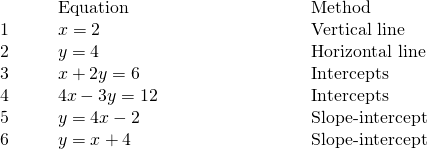
Equations #ane and #2 each have simply one variable. Remember, in equations of this grade the value of that one variable is constant; it does not depend on the value of the other variable. Equations of this grade have graphs that are vertical or horizontal lines.
In equations #iii and #4, both and are on the same side of the equation. These two equations are of the form  . We substituted
  to observe the x-intercept and
  to find the y-intercept, and and so found a 3rd indicate by choosing some other value for or .
Equations #5 and #6 are written in slope–intercept class. Later identifying the slope and y-intercept from the equation nosotros used them to graph the line.
This leads to the following strategy.
Strategy for Choosing the Almost Convenient Method to Graph a Line
Consider the form of the equation.
Determine the near user-friendly method to graph each line.
ⓐ  ⓑ
ⓑ  ⓒ
ⓒ  ⓓ .
ⓓ .
Determine the well-nigh user-friendly method to graph each line: ⓐ ⓑ  ⓒ
ⓒ  ⓓ
ⓓ  .
.
ⓐ interceptsⓑ horizontal lineⓒ slope–interceptⓓ vertical line
Determine the most convenient method to graph each line: ⓐ  ⓑ
ⓑ  ⓒ
ⓒ  ⓓ
ⓓ  .
.
ⓐ vertical lineⓑ slope–interceptⓒ horizontal lineⓓ intercepts
Graph and Interpret Applications of Slope–Intercept
Many real-world applications are modeled past linear equations. We will take a expect at a few applications here so you can see how equations written in slope–intercept form relate to real-world situations.
Commonly when a linear equation models a existent-world state of affairs, different letters are used for the variables, instead of 10 and y. The variable names remind united states of america of what quantities are being measured.
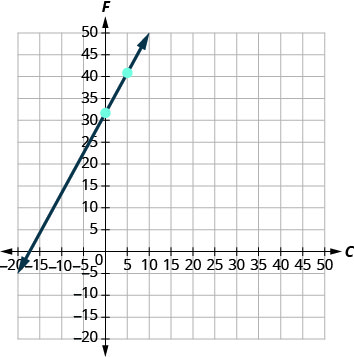
The equation 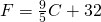 is used to convert temperatures,
  , on the Celsius calibration to temperatures,
  , on the Fahrenheit calibration.
ⓐ Observe the Fahrenheit temperature for a Celsius temperature of 0.
ⓑ Notice the Fahrenheit temperature for a Celsius temperature of 20.
ⓒ Translate the slope and F-intercept of the equation.
ⓓ Graph the equation.
Solution
| ⓐ Find the Fahrenheit temperature for a Celsius temperature of 0. Find when  . . Simplify. | 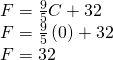 |
| ⓑ Find the Fahrenheit temperature for a Celsius temperature of twenty. Discover when  . . Simplify. Simplify. | 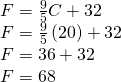 |
ⓒ Translate the slope and F-intercept of the equation.
Even though this equation uses and , it is still in slope–intercept grade.
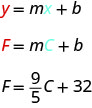
The slope,  , ways that the temperature Fahrenheit (F) increases ix degrees when the temperature Celsius (C) increases 5 degrees.
The F-intercept means that when the temperature is  on the Celsius scale, information technology is
  on the Fahrenheit scale.
ⓓ Graph the equation.
We'll need to use a larger scale than our usual. Start at the F-intercept  then count out the rise of 9 and the run of 5 to get a second indicate. See (Figure).
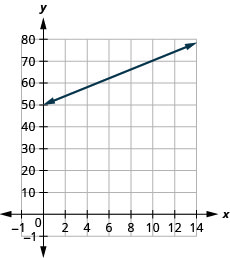
The equation  is used to approximate a woman's top in inches, h, based on her shoe size, south.
ⓐ Estimate the elevation of a child who wears women'south shoe size 0.
ⓑ Judge the tiptop of a woman with shoe size 8.
ⓒ Interpret the slope and h-intercept of the equation.
ⓓ Graph the equation.
- ⓐ fifty inches
- ⓑ 66 inches
- ⓒ The slope, two, ways that the peak, h, increases by ii inches when the shoe size, s, increases by 1. The h-intercept means that when the shoe size is 0, the meridian is 50 inches.
- ⓓ
The equation  is used to estimate the temperature in degrees Fahrenheit, T, based on the number of cricket chirps, northward, in one infinitesimal.
ⓐ Estimate the temperature when in that location are no chirps.
ⓑ Approximate the temperature when the number of chirps in one infinitesimal is 100.
ⓒ Interpret the slope and T-intercept of the equation.
ⓓ Graph the equation.
The cost of running some types business concern has two components—a fixed cost and a variable cost. The fixed cost is ever the same regardless of how many units are produced. This is the price of rent, insurance, equipment, advert, and other items that must be paid regularly. The variable price depends on the number of units produced. It is for the textile and labor needed to produce each detail.
Stella has a home business organization selling gourmet pizzas. The equation  models the relation between her weekly cost, C, in dollars and the number of pizzas, p, that she sells.
ⓐ Find Stella'due south cost for a week when she sells no pizzas.
ⓑ Find the cost for a week when she sells xv pizzas.
ⓒ Interpret the slope and C-intercept of the equation.
ⓓ Graph the equation.
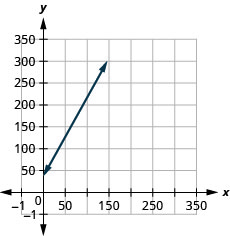
Sam drives a commitment van. The equation  models the relation between his weekly price, C, in dollars and the number of miles, m, that he drives.
ⓐ Find Sam'due south cost for a week when he drives 0 miles.
ⓑ Find the toll for a week when he drives 250 miles.
ⓒ Translate the slope and C-intercept of the equation.
ⓓ Graph the equation.
- ⓐ ?lx
- ⓑ ?185
- ⓒ The slope, 0.v, means that the weekly price, C, increases by ?0.50 when the number of miles driven, n, increases by one. The C-intercept means that when the number of miles driven is 0, the weekly toll is ?60
- ⓓ
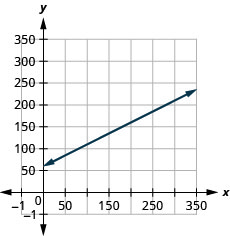
Loreen has a calligraphy business organisation. The equation  models the relation between her weekly cost, C, in dollars and the number of nuptials invitations, n, that she writes.
ⓐ Find Loreen'southward toll for a week when she writes no invitations.
ⓑ Find the cost for a week when she writes 75 invitations.
ⓒ Interpret the slope and C-intercept of the equation.
ⓓ Graph the equation.
- ⓐ ?35
- ⓑ ?170
- ⓒ The gradient, 1.8, means that the weekly cost, C, increases past ?ane.80 when the number of invitations, due north, increases by 1.fourscore.
The C-intercept ways that when the number of invitations is 0, the weekly cost is ?35.; - ⓓ
Utilise Slopes to Identify Parallel Lines
The slope of a line indicates how steep the line is and whether it rises or falls as nosotros read it from left to right. Ii lines that have the same slope are chosen parallel lines. Parallel lines never intersect.

We say this more formally in terms of the rectangular coordinate arrangement. Two lines that take the same gradient and different y-intercepts are called parallel lines. Come across (Figure).
Verify that both lines have the aforementioned gradient,  , and different y-intercepts.
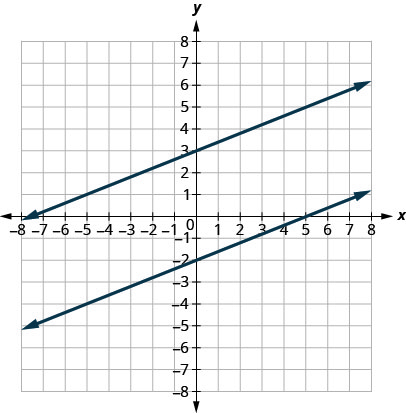
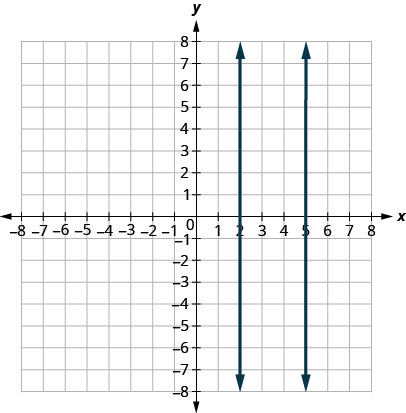
What about vertical lines? The gradient of a vertical line is undefined, then vertical lines don't fit in the definition above. We say that vertical lines that have different x-intercepts are parallel. See (Figure).
Vertical lines with diferent ten-intercepts are parallel.
Parallel Lines
Parallel lines are lines in the aforementioned plane that do non intersect.
Let's graph the equations  and
and  on the same grid. The showtime equation is already in slope–intercept grade: . We solve the second equation for :
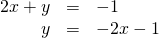
Graph the lines.
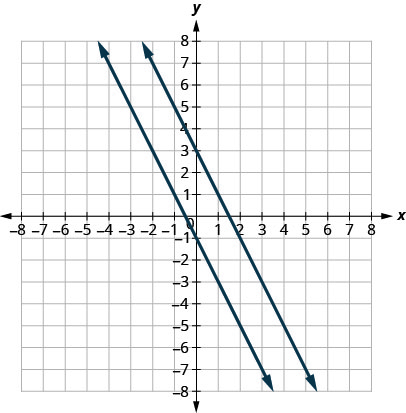
Notice the lines wait parallel. What is the slope of each line? What is the y-intercept of each line?

The slopes of the lines are the same and the y-intercept of each line is different. So we know these lines are parallel.
Since parallel lines have the same slope and different y-intercepts, we tin can now just look at the slope–intercept form of the equations of lines and make up one's mind if the lines are parallel.
Employ slopes and y-intercepts to determine if the lines  and
and  are parallel.
Use slopes and y-intercepts to determine if the lines  are parallel.
parallel
Use slopes and y-intercepts to determine if the lines  are parallel.
parallel
Employ slopes and y-intercepts to determine if the lines  and
and  are parallel.
Use slopes and y-intercepts to decide if the lines  are parallel.
parallel
Use slopes and y-intercepts to determine if the lines  are parallel.
parallel
Use slopes and y-intercepts to determine if the lines  and
and  are parallel.
Solution

Since there is no, the equations cannot be put in gradient–intercept form. But we recognize them as equations of vertical lines. Their 10-intercepts are  and
and  . Since their 10-intercepts are different, the vertical lines are parallel.
Utilize slopes and y-intercepts to decide if the lines  and are parallel.
parallel
Use slopes and y-intercepts to determine if the lines  and
and  are parallel.
parallel
Employ slopes and y-intercepts to decide if the lines and  are parallel. You may want to graph these lines, too, to see what they look like.
Use slopes and y-intercepts to determine if the lines  and
and  are parallel.
non parallel; same line
Use slopes and y-intercepts to determine if the lines  and
and  are parallel.
not parallel; same line
Use Slopes to Place Perpendicular Lines
Let'southward look at the lines whose equations are  and
and  , shown in (Effigy).
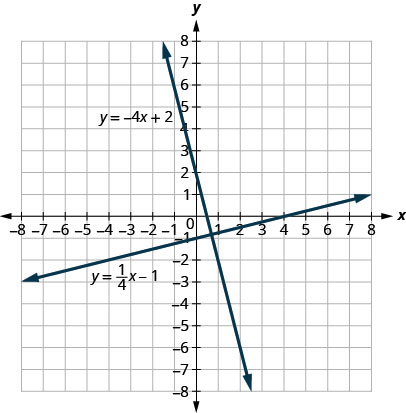
These lines prevarication in the same plane and intersect in right angles. Nosotros phone call these lines perpendicular.
What do yous notice virtually the slopes of these two lines? As we read from left to right, the line rises, and so its gradient is positive. The line drops from left to right, and then it has a negative slope. Does it make sense to y'all that the slopes of two perpendicular lines volition have opposite signs?
If nosotros wait at the slope of the first line,  , and the slope of the 2nd line,
  , nosotros can encounter that they are negative reciprocals of each other. If we multiply them, their product is

This is always true for perpendicular lines and leads united states of america to this definition.
Perpendicular Lines
Perpendicular lines are lines in the same plane that form a correct angle.
If  are the slopes of 2 perpendicular lines, and so:

Vertical lines and horizontal lines are e'er perpendicular to each other.
We were able to expect at the slope–intercept form of linear equations and make up one's mind whether or not the lines were parallel. Nosotros tin do the same thing for perpendicular lines.
We find the slope–intercept form of the equation, and then see if the slopes are negative reciprocals. If the product of the slopes is  , the lines are perpendicular. Perpendicular lines may have the same y-intercepts.
Utilise slopes to make up one's mind if the lines,  and
and  are perpendicular.
Solution
| The offset equation is already in slope-intercept form. |  | |
| Solve the second equation for . | 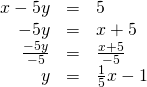 | |
| Identify the gradient of each line. | 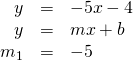 | 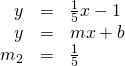 |
The slopes are negative reciprocals of each other, so the lines are perpendicular. We check by multiplying the slopes,

Use slopes to make up one's mind if the lines  and
and  are perpendicular.
perpendicular
Apply slopes to make up one's mind if the lines  and
and  are perpendicular.
perpendicular
Use slopes to decide if the lines,  and
and  are perpendicular.
Apply slopes to decide if the lines  and
and  are perpendicular.
not perpendicular
Employ slopes to determine if the lines  and
and  are perpendicular.
not perpendicular
Key Concepts
Exercise Makes Perfect
Recognize the Relation Between the Graph and the Gradient–Intercept Class of an Equation of a Line
In the following exercises, use the graph to notice the gradient and y-intercept of each line. Compare the values to the equation .

Identify the Slope and y-Intercept From an Equation of a Line
In the following exercises, place the slope and y-intercept of each line.


Graph a Line Using Its Slope and Intercept
In the following exercises, graph the line of each equation using its slope and y-intercept.



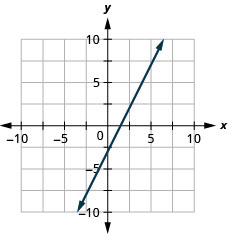


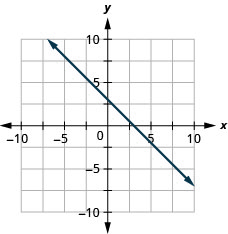


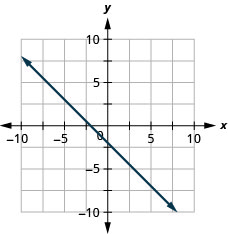


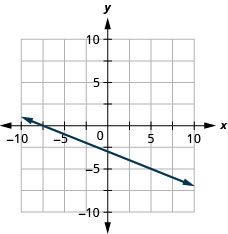


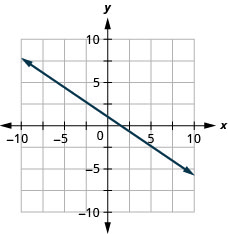


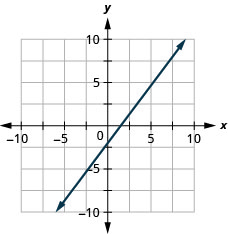


Choose the Nigh Convenient Method to Graph a Line
In the following exercises, determine the about user-friendly method to graph each line.

horizontal line


vertical line


slope–intercept


intercepts

slope–intercept


horizontal line


intercepts


gradient–intercept
Graph and Interpret Applications of Slope–Intercept
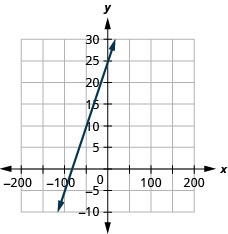
The equation  models the relation between the corporeality of Tuyet's monthly water bill payment, P, in dollars, and the number of units of water, westward, used.
- ⓐ Find Tuyet'due south payment for a month when 0 units of water are used.
- ⓑ Find Tuyet's payment for a month when 12 units of water are used.
- ⓒ Interpret the slope and P-intercept of the equation.
- ⓓ Graph the equation.
The equation  models the relation between the amount of Randy's monthly h2o bill payment, P, in dollars, and the number of units of water, due west, used.
- ⓐ Find the payment for a calendar month when Randy used 0 units of water.
- ⓑ Find the payment for a month when Randy used 15 units of water.
- ⓒ Translate the gradient and P-intercept of the equation.
- ⓓ Graph the equation.
- ⓐ ?28
- ⓑ ?66.10
- ⓒ The slope, two.54, means that Randy'due south payment, P, increases by ?2.54 when the number of units of h2o he used, w, increases past ane. The P–intercept ways that if the number units of water Randy used was 0, the payment would be ?28.
- ⓓ
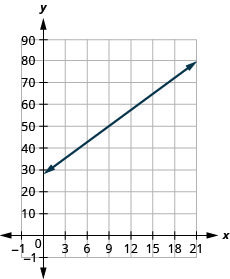
Bruce drives his motorcar for his job. The equation  models the relation between the corporeality in dollars, R, that he is reimbursed and the number of miles, thou, he drives in one twenty-four hours.
- ⓐ Observe the corporeality Bruce is reimbursed on a mean solar day when he drives 0 miles.
- ⓑ Detect the amount Bruce is reimbursed on a twenty-four hours when he drives 220 miles.
- ⓒ Interpret the gradient and R-intercept of the equation.
- ⓓ Graph the equation.
Janelle is planning to hire a car while on holiday. The equation  models the relation between the toll in dollars, C, per day and the number of miles, grand, she drives in one twenty-four hours.
- ⓐ Find the toll if Janelle drives the car 0 miles one mean solar day.
- ⓑ Find the cost on a 24-hour interval when Janelle drives the auto 400 miles.
- ⓒ Interpret the slope and C–intercept of the equation.
- ⓓ Graph the equation.
- ⓐ ?15
- ⓑ ?143
- ⓒ The slope, 0.32, means that the price, C, increases past ?0.32 when the number of miles driven, m, increases by 1. The C-intercept means that if Janelle drives 0 miles one day, the price would be ?15.
- ⓓ
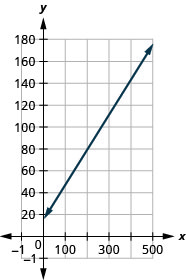
Cherie works in retail and her weekly salary includes commission for the amount she sells. The equation  models the relation betwixt her weekly salary, S, in dollars and the amount of her sales, c, in dollars.
- ⓐ Notice Cherie'southward salary for a calendar week when her sales were 0.
- ⓑ Find Cherie'south salary for a calendar week when her sales were 3600.
- ⓒ Translate the slope and Due south–intercept of the equation.
- ⓓ Graph the equation.
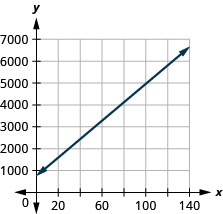
Patel's weekly salary includes a base pay plus committee on his sales. The equation  models the relation betwixt his weekly salary, S, in dollars and the amount of his sales, c, in dollars.
- ⓐ Detect Patel'south bacon for a week when his sales were 0.
- ⓑ Find Patel's salary for a calendar week when his sales were eighteen,540.
- ⓒ Interpret the slope and S-intercept of the equation.
- ⓓ Graph the equation.
- ⓐ ?750
- ⓑ ?2418.sixty
- ⓒ The gradient, 0.09, means that Patel's salary, Southward, increases by ?0.09 for every ?1 increment in his sales. The S-intercept means that when his sales are ?0, his salary is ?750.
- ⓓ
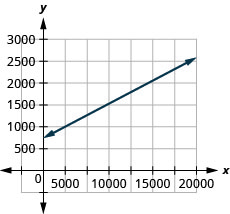
Costa is planning a lunch banquet. The equation  models the relation betwixt the cost in dollars, C, of the banquet and the number of guests, 1000.
- ⓐ Find the cost if the number of guests is forty.
- ⓑ Find the cost if the number of guests is lxxx.
- ⓒ Translate the slope and C-intercept of the equation.
- ⓓ Graph the equation.
Margie is planning a dinner banquet. The equation  models the relation between the cost in dollars, C of the banquet and the number of guests, g.
- ⓐ Detect the cost if the number of guests is 50.
- ⓑ Find the cost if the number of guests is 100.
- ⓒ Translate the gradient and C–intercept of the equation.
- ⓓ Graph the equation.
- ⓐ ?2850
- ⓑ ?4950
- ⓒ The gradient, 42, means that the cost, C, increases past ?42 for when the number of guests increases by 1. The C-intercept means that when the number of guests is 0, the cost would exist ?750.
- ⓓ
Use Slopes to Identify Parallel Lines
In the post-obit exercises, employ slopes and y-intercepts to decide if the lines are parallel.


parallel


parallel


not parallel


parallel


parallel


parallel


parallel


parallel


non parallel


not parallel


not parallel


not parallel


not parallel
Use Slopes to Identify Perpendicular Lines
In the following exercises, use slopes and y-intercepts to decide if the lines are perpendicular.


perpendicular


perpendicular


non perpendicular


not perpendicular


perpendicular


perpendicular
Everyday Math
The equation  can be used to convert temperatures F, on the Fahrenheit scale to temperatures, C, on the Celsius scale.
- ⓐ Explain what the slope of the equation means.
- ⓑ Explain what the C–intercept of the equation means.
The equation  is used to gauge the number of cricket chirps, n, in one minute based on the temperature in degrees Fahrenheit, T.
- ⓐ Explain what the slope of the equation ways.
- ⓑ Explain what the n–intercept of the equation means. Is this a realistic situation?
Writing Exercises
Explain in your own words how to determine which method to use to graph a line.
Why are all horizontal lines parallel?
Answers will vary.
Cocky Cheque
ⓐ Later completing the exercises, use this checklist to evaluate your mastery of the objectives of this section.
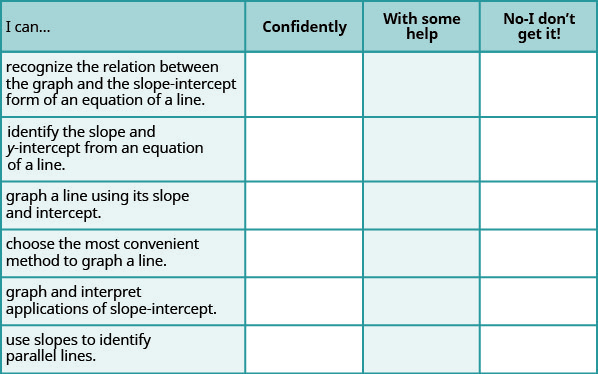
ⓑ After looking at the checklist, exercise you remember you are well-prepared for the adjacent section? Why or why not?
Source: https://opentextbc.ca/elementaryalgebraopenstax/chapter/use-the-slope-intercept-form-of-an-equation-of-a-line/
0 Response to "what is the equation of the line parallel to the given line with an x-intercept of 4? y = x +"
Post a Comment